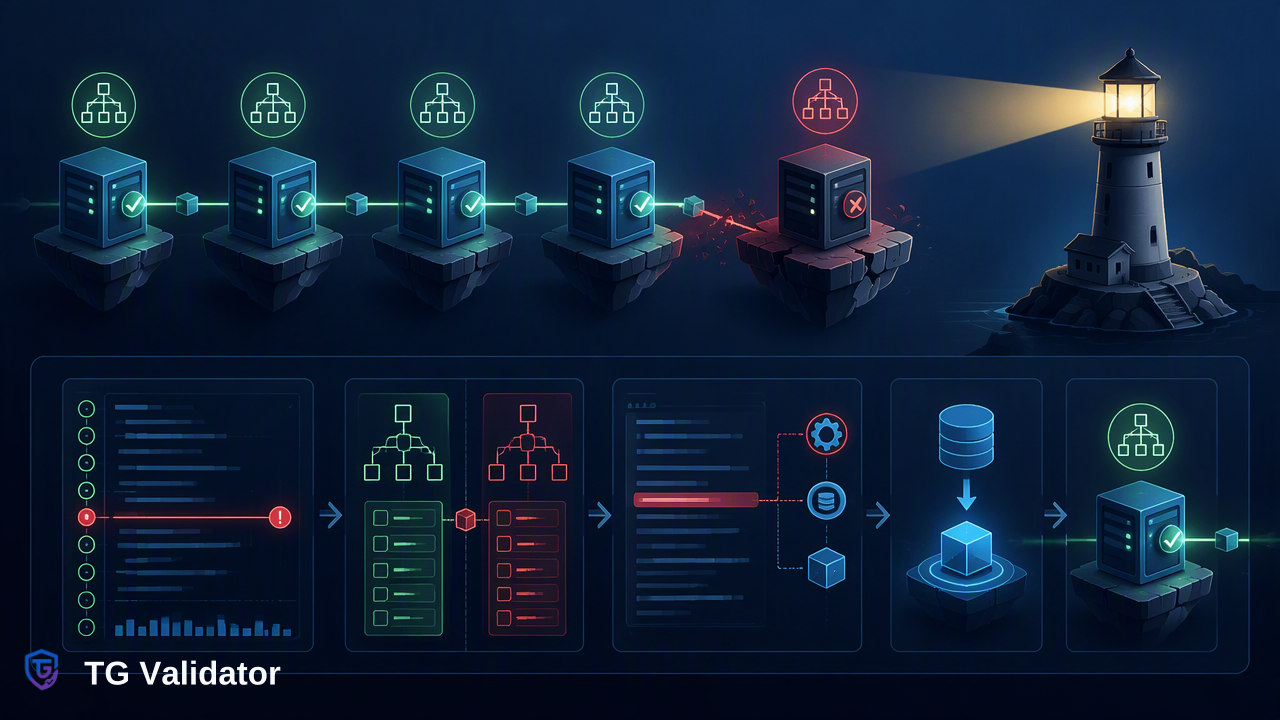
Transitioning Between Consensus Protocol Versions in Distributed Validation Networks
Upgrading validation logic requires a multi-phase approach to state synchronization that prevents network forks and ensures backward compatibility during the transition period.
In distributed validation networks, the state transition function acts as the source of truth. When a protocol requires an upgrade—such as changing how transactions are hashed, how signatures are verified, or how state roots are calculated—the network faces a significant risk: a hard fork. If nodes do not synchronize their transition to the new logic at the exact same block height, the network splits, with different segments of the validator set producing incompatible blocks.
Transitioning between versions requires a multi-phase approach that prioritizes backward compatibility and state consistency. This guide explores the engineering patterns necessary to execute these upgrades without downtime or chain splits.
The Problem: State Divergence
A distributed network relies on every node reaching the same conclusion about the state of the system. If you update the validation logic on 50% of your nodes, those nodes will reject blocks produced by the remaining 50% that are still using the legacy logic. This is the classic definition of a hard fork.
To avoid this, the upgrade must be treated as a state-dependent event rather than a simple software deployment. The goal is to ensure that all nodes are capable of verifying both the old and new logic for a specific window of time.
Phase 1: Dual-Path Validation
The most robust way to handle an upgrade is to implement a dual-path validation layer. Instead of replacing the old function, you wrap both the legacy and the new logic within a conditional gate.
During the transition period, the node checks the block height or the epoch index. If the current height is below the upgrade threshold, the node executes the legacy function. If it is at or above the threshold, it executes the new function.
function validate_block(block, current_height):
    if current_height < UPGRADE_HEIGHT:
        return legacy_verify(block)
    else:
        return new_verify(block)
This approach allows nodes to remain compatible with the network regardless of when they update their binaries, provided they update before the UPGRADE_HEIGHT is reached.
Phase 2: The "Soft" Transition Window
A common mistake is to set the UPGRADE_HEIGHT too close to the current block height. This leaves little room for node operators to react to unexpected issues. A safer approach is to define a "grace period" where the network supports both versions.
During this window, nodes should be configured to:
- Verify both: If the node is updated, it should be able to verify blocks produced by legacy nodes and new-logic nodes.
- Produce only one: The node should be configured to produce blocks using the new logic only after the threshold is crossed.
This creates a "compatibility buffer." If a validator fails to update in time, they will be unable to produce valid blocks, but they will still be able to sync the chain because their node can still verify the legacy blocks produced by others.
A Concrete Failure: The "Off-by-One" Error
In one observed instance, a network upgrade failed because the UPGRADE_HEIGHT was defined as the block after the last legacy block, but the implementation logic used a strict inequality (<) that triggered the new logic one block too early.
Because the state transition function changed the way transaction fees were calculated, the nodes that upgraded early produced a block with a different state root than the nodes that were still on the legacy logic. This resulted in a temporary chain split that lasted for three blocks until the majority of the network reached the actual threshold.
The lesson here is that state transition logic must be tested against the exact boundary condition. Always verify the transition at UPGRADE_HEIGHT - 1, UPGRADE_HEIGHT, and UPGRADE_HEIGHT + 1.
Edge Case: State Snapshot Inconsistency
What happens if a new node joins the network during the transition? If the node downloads a state snapshot from a peer, it needs to know which logic to use to verify that snapshot.
If the snapshot was taken at a height where the logic changed, the node might attempt to verify the snapshot using the wrong transition function. To mitigate this, the snapshot metadata must include the protocol version used to generate it. The node must then select the appropriate validation logic based on the snapshot's version, not just the current chain height.
When Migration is the Wrong Choice
Not every protocol change requires a complex multi-phase migration. If the change is purely additive—such as adding a new, optional field to a transaction—you might not need a hard fork at all. You can use feature flags or optional fields that legacy nodes simply ignore.
Migration is the wrong choice when:
- The change is cosmetic: If the change does not affect the state root or consensus, do not force a network-wide upgrade.
- The network is small and centralized: If you have full control over all nodes, a coordinated restart is faster and less prone to logic errors than a dual-path implementation.
- The cost of complexity outweighs the benefit: If the dual-path logic introduces significant technical debt or performance overhead, consider if the protocol change is truly necessary.
Rollback Criteria
Before initiating an upgrade, define clear rollback criteria. If the network experiences a high rate of block rejection or if the state root diverges across nodes, the upgrade must be halted.
The most effective rollback strategy is to have a "kill switch" in the node configuration that allows operators to revert to the legacy validation logic immediately. However, this is only possible if the legacy logic is still present in the codebase. This is why keeping the legacy code in the binary for at least one full epoch after the upgrade is a standard safety practice.
Summary of Best Practices
- Decouple deployment from activation: Deploy the new code well before the
UPGRADE_HEIGHT. - Use conditional logic: Gate the new transition function behind a block-height check.
- Test the boundary: Run simulations specifically for the block at the transition threshold.
- Maintain legacy code: Keep the old logic in the codebase until the network has successfully passed the upgrade threshold and stabilized.
- Snapshot versioning: Ensure state snapshots are tagged with the protocol version to prevent synchronization errors for new nodes.
By treating the protocol upgrade as a state-dependent transition rather than a simple software update, you minimize the risk of network splits and ensure that the validator set remains synchronized throughout the migration process.