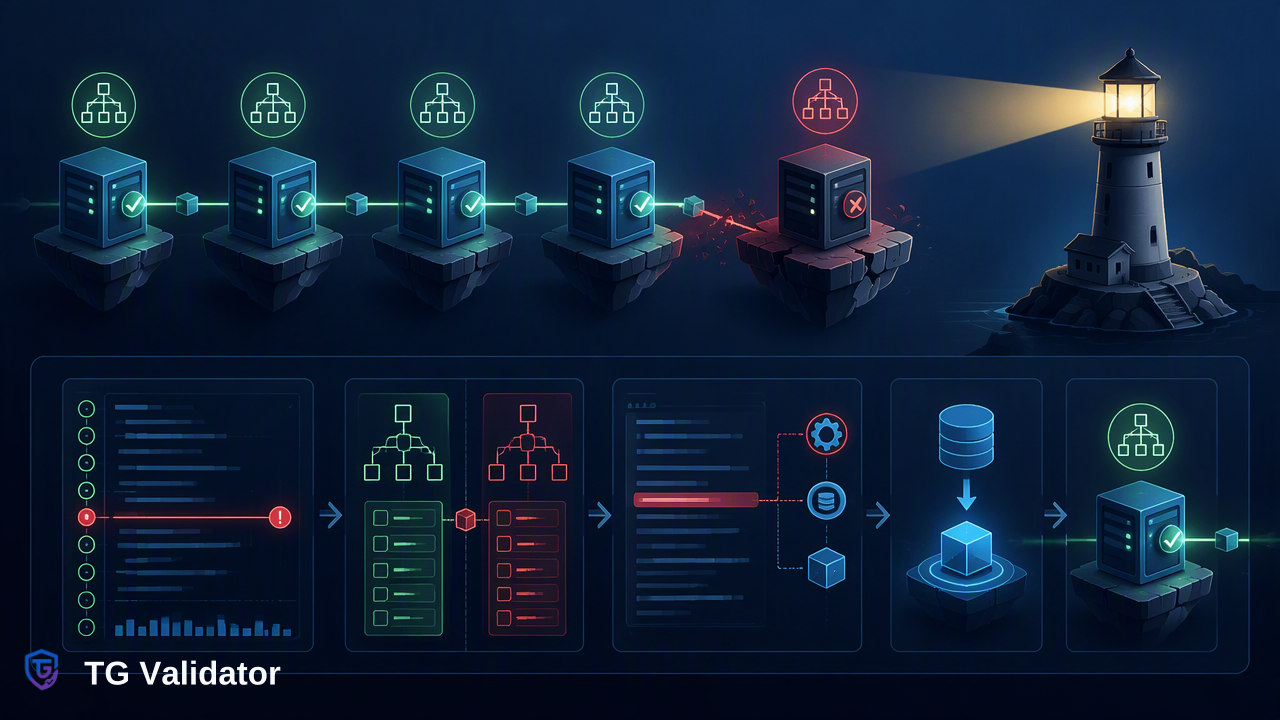
Migrating Between Consensus State Serialization Formats in Distributed Validation
Transitioning serialization schemas in a live validation environment requires a multi-phase approach to maintain state consistency and prevent network-wide forks during protocol upgrades.
In distributed systems, the state of the network is the ground truth. When a protocol evolves to require a more efficient serialization format—such as moving from a verbose JSON-based state representation to a compact binary schema like Protocol Buffers or a custom byte-aligned format—the migration process is rarely a simple "flip the switch" operation. In a live validation environment, where nodes must reach consensus on the state root, any discrepancy in how data is serialized or deserialized can lead to catastrophic network forks.
The Challenge of State Consistency
The primary constraint in any distributed validation network is that every node must arrive at the exact same state root after processing a block. If Node A serializes a state update using a legacy format and Node B uses a new, more efficient binary format, their resulting hashes will diverge even if the underlying data is semantically identical.
A common failure mode occurs when developers assume that serialization is an isolated concern. In reality, serialization is deeply coupled with the consensus engine. If the network upgrades the serialization format, the protocol must ensure that all nodes can interpret both the legacy and the new formats during the transition period. Failure to account for this leads to a "split-brain" scenario where the network partitions into two incompatible groups, each rejecting the other's blocks as invalid.
The Multi-Phase Migration Strategy
To safely migrate serialization schemas, engineers should adopt a multi-phase approach that decouples the ability to read data from the requirement to write it in the new format.
Phase 1: Dual-Format Read Support
Before any data is written in the new format, every node must be updated to support reading both the legacy and the new schemas. During this phase, the system remains in a "legacy-write" mode. The software is updated to include a decoder that checks the version byte or header of the serialized data. If the header indicates the legacy format, it uses the old parser; if it indicates the new format, it uses the new parser. This ensures that when the transition begins, nodes are already capable of processing the new data structure.
Phase 2: Incremental Write Transition
Once all nodes are running the dual-read code, the network can begin writing in the new format. This is often done via a feature flag or a block-height-based activation. It is critical that this transition is deterministic. For example, the protocol might specify that at block height N, all new state updates must be serialized using the new binary schema. Because all nodes have already been upgraded to support reading both formats, they can continue to process legacy data from older blocks while correctly interpreting new data from block N onwards.
Phase 3: Legacy Cleanup
After a sufficient buffer period—often spanning several thousand blocks or a full epoch—the legacy serialization code can be deprecated and eventually removed. This phase should only occur once the network has reached consensus on a state root that is entirely derived from the new serialization format.
A Surprising Observation: The "Ghost" State
During a recent migration in a distributed cluster, a team observed that even after the transition to a binary format, some nodes were still producing different state roots. The investigation revealed that the legacy serialization library was non-deterministic regarding map iteration order. While the data looked identical when printed, the binary output varied depending on the internal memory layout of the node. This serves as a reminder that serialization is not just about the schema; it is about the deterministic transformation of memory into bytes. When migrating, one must ensure that the new serialization logic enforces strict ordering (e.g., sorting keys in a map) to prevent non-deterministic output.
Counterexample: When Migration is the Wrong Choice
Migration is not always the correct path. If the legacy serialization format is already performant enough for the current throughput requirements, the risk of a network fork during a migration may outweigh the benefits of a smaller state footprint.
Furthermore, if the validation network relies on external tooling—such as indexers, block explorers, or third-party monitoring services—that are not under the control of the core protocol team, a serialization change can break the entire ecosystem. If these external services cannot be updated in lockstep with the nodes, the migration will effectively blind the network's observability layer. In such cases, it is often safer to implement a "sidecar" approach, where the new data is stored in a separate, parallel structure rather than replacing the existing consensus state.
Rollback Criteria and Safety
A migration plan is incomplete without explicit rollback criteria. If the network experiences a spike in block rejection rates or if the state root mismatches exceed a predefined threshold, the protocol must be able to revert to the legacy serialization mode. This requires that the "dual-read" logic remains active even after the "write" transition. If the new format proves unstable, the network can trigger a coordinated revert to the legacy format, provided the nodes have not discarded the legacy serialization logic.
Trade-offs and Limitations
The primary trade-off in this multi-phase approach is increased code complexity. Maintaining two serialization paths simultaneously increases the surface area for bugs and requires more rigorous testing. Additionally, the binary format, while more efficient, is often less human-readable than JSON. This can complicate debugging, as engineers can no longer simply inspect the raw state in a text editor.
When designing these systems, always prioritize deterministic serialization. Whether using binary schemas or text-based formats, the transformation from state to bytes must be identical across all hardware architectures and language implementations. If the protocol requires high-performance validation, ensure that the serialization library is optimized for the specific access patterns of the consensus engine, rather than just focusing on the final byte size.
For those managing node infrastructure, always consult the current protocol documentation regarding serialization versioning. Understanding the specific constraints of your validation environment—such as how the network handles concurrency or timeout behavior during state synchronization—is essential for maintaining a stable, fork-free distributed system.