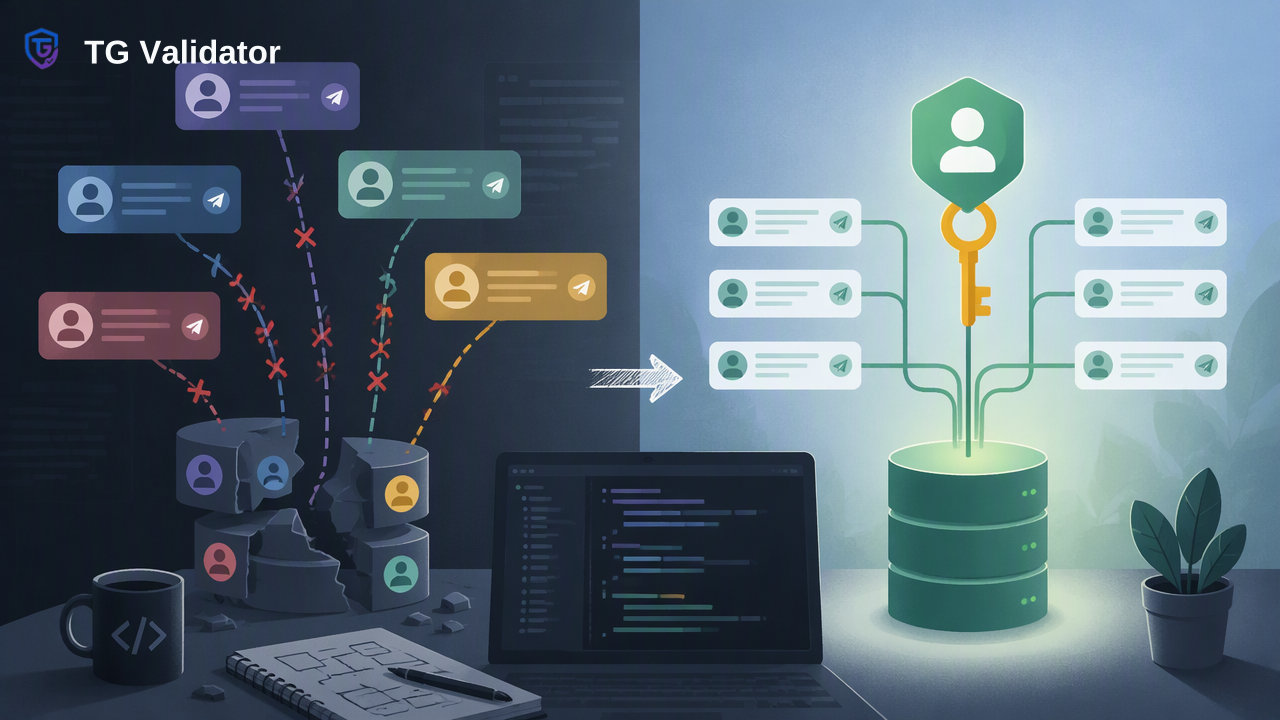
Managing Asynchronous State Transitions in High-Volume Message Validation
When validating incoming message streams, race conditions occur if state updates are not atomic; implementing a locking mechanism or queue-based processing is essential to maintain data integrity.
The Challenge of Concurrent State Transitions
In high-volume backend systems, the requirement to validate incoming identifiers—such as phone numbers or usernames—often leads to a common architectural trap. When multiple services or concurrent threads attempt to validate the same identifier simultaneously, the system can fall into a race condition. This results in duplicate processing, redundant API calls, and inconsistent database states.
Consider a scenario where your application receives a stream of incoming requests. Each request triggers a validation process. If two requests for the same identifier arrive within milliseconds of each other, and your system does not have a mechanism to synchronize these operations, both requests will proceed to the validation layer. This is not merely inefficient; it creates a "split-brain" scenario where the database might record conflicting statuses or trigger multiple billing events for a single logical entity.
Diagnosing the Race Condition
The root cause of this issue is the lack of atomicity in the "check-then-act" pattern. A typical, naive implementation looks like this:
- Check: Query the database to see if the identifier has already been validated.
- Act: If not found, call the external validation service.
- Update: Write the result to the database.
In a high-volume environment, the time gap between Step 1 and Step 3 is the window of vulnerability. If Request A is at Step 2, Request B will see that the identifier is not in the database and will also proceed to Step 2. Both requests will eventually attempt to write to the database, potentially causing primary key violations or overwriting each other's data.
Implementing Atomic Synchronization
To solve this, you must ensure that the validation process for a specific identifier is serialized. There are two primary ways to achieve this: distributed locking or queue-based processing.
Distributed Locking
Using a distributed lock (e.g., via Redis) allows you to gate access to the validation logic. Before initiating a check, the application attempts to acquire a lock keyed by the identifier.
# Hypothetical implementation using a distributed lock
lock_key = f"lock:validate:{identifier}"
if redis.set(lock_key, "locked", nx=True, ex=30):
    try:
        # Perform validation
        result = external_service.check(identifier)
        db.save(identifier, result)
    finally:
        redis.delete(lock_key)
else:
    # Wait or return a "processing" status
    return {"status": "in_progress"}
This approach ensures that only one process handles the validation for a specific identifier at any given time. The nx=True flag ensures the operation is atomic, and the ex=30 expiration prevents deadlocks if a process crashes.
Queue-Based Processing
Alternatively, you can decouple the request from the validation by pushing the identifier into a message queue. A worker pool then consumes these messages. By using a consistent hashing strategy on the queue, you can ensure that all requests for the same identifier are routed to the same worker instance, effectively serializing the processing without needing a global lock.
Trade-offs and Limitations
Every architectural decision involves trade-offs. Distributed locking introduces a dependency on your caching layer. If your Redis cluster is unavailable, your validation pipeline halts. Furthermore, if your validation service has strict concurrency limits—such as the documented five in-flight checks for certain API integrations—you must ensure your locking mechanism does not inadvertently starve the system by holding locks too long while waiting for API responses.
Queue-based processing offers better scalability and resilience but introduces latency. The user no longer receives an immediate response. You must implement a polling mechanism or a webhook to notify the client when the validation is complete.
Handling Asynchronous Bulk Tasks
When dealing with large datasets, the approach shifts from real-time synchronization to batch processing. For instance, when uploading a file of 1,000 to 500,000 entries, you are not managing individual request race conditions but rather the lifecycle of a bulk task.
In this context, the state transition is managed by the service provider. You submit a file, receive a task ID, and poll for completion. The critical engineering decision here is to respect the provider's constraints. For example, polling the status of a bulk task more frequently than once every 30 seconds is unnecessary and can lead to rate-limiting or inefficient resource usage.
Edge Cases: The "Undecided" Result
A common pitfall is assuming that every API call results in a definitive "registered" or "not registered" status. In reality, validation services may return non-zero business codes for undecided checks.
If your system treats an "undecided" result as a failure and immediately retries, you risk entering an infinite loop of redundant requests. Always implement an exponential backoff strategy for retries and ensure that your database schema can distinguish between a successful validation, a failed attempt, and an "undecided" state that requires manual intervention or a later retry.
Key Takeaways for System Architects
- Atomicity is Non-Negotiable: Never rely on the database to resolve race conditions after the fact. Use distributed locks or message queues to serialize access to validation logic at the application level.
- Respect Concurrency Limits: Always consult the API documentation for your specific service. Understanding the documented in-flight limits (e.g., five concurrent checks) is essential for designing a robust worker pool.
- Decouple for Scale: For high-volume streams, move away from synchronous request-response patterns. Asynchronous bulk processing is significantly more efficient for large datasets and avoids the complexities of managing thousands of individual concurrent connections.
- Handle Partial Failures: Design your state machine to handle "undecided" or "processing" states gracefully. Do not assume every API call will return a final result on the first attempt.
- Data Minimization: In line with data protection principles, ensure that you only store the validation results necessary for your business logic, keeping your database footprint lean and compliant.
About the author
- https://tgvalidator.com Check if a phone number is registered on Telegram. Verify a single number instantly.
Comments
Join the discussionNo comments yet. Be the first to comment.