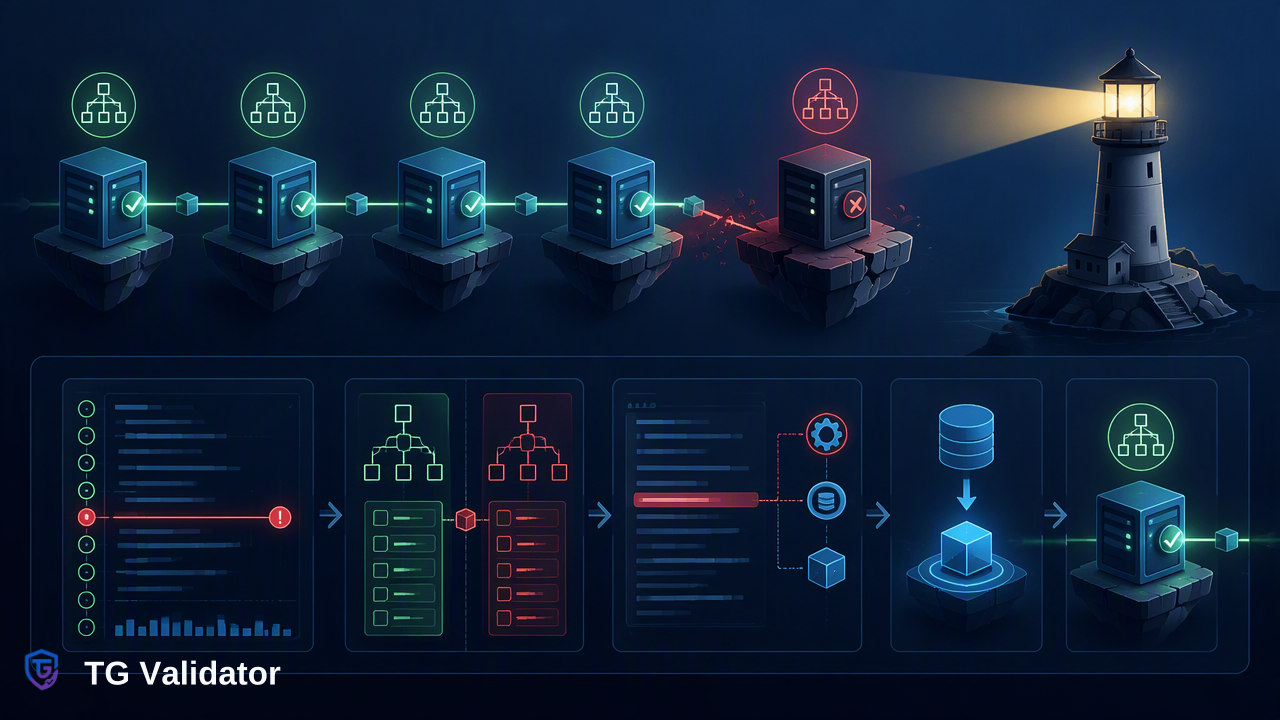
Handling Reorg-Induced State Rollbacks in Distributed Validation
Maintaining state integrity during chain reorganizations requires a decoupled architecture that separates speculative execution from finalized state storage to prevent inconsistent ledger views.
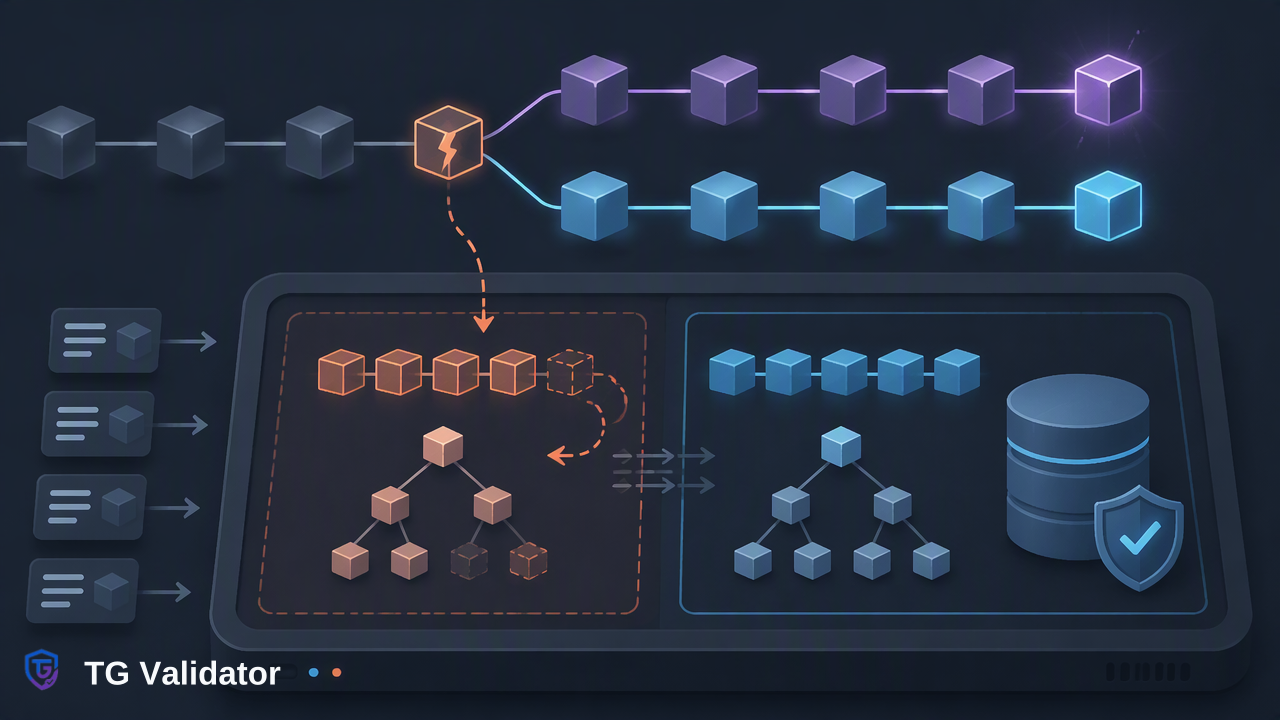
In distributed ledger systems, the assumption of a linear, immutable history is a convenient abstraction that rarely survives contact with network latency and consensus competition. When a node receives a block that triggers a chain reorganization (reorg), the local state—often a Merkle Patricia Trie or similar structure—must be reconciled with the new, canonical chain.
The engineering challenge is not merely reverting the state; it is doing so without corrupting the finalized database or introducing significant latency for incoming transaction processing. This article explores an architectural approach to decoupling speculative execution from finalized state storage to maintain system integrity during these events.
The Problem: State Inconsistency
When a node processes a block, it typically updates its local state trie. If the network reaches consensus on a different branch, the node must discard the current, "speculative" state and roll back to the last known common ancestor.
A common failure mode occurs when the system attempts to perform this rollback in-place on the primary database. If the process is interrupted—due to a crash, power loss, or memory pressure—the database may be left in a partially updated state. This "torn" state is notoriously difficult to recover from, often requiring a full re-sync from the genesis block, which is unacceptable for high-availability infrastructure.
Architectural Decision: Decoupled State Layers
To mitigate this, we adopt a decoupled architecture that separates the Speculative Execution Layer from the Finalized State Layer.
1. The Finalized State Layer (Read-Only/Append-Only)
This layer stores the state that has reached a sufficient depth to be considered immutable. It is treated as a read-only source of truth for the application layer. Updates to this layer are performed via atomic snapshots or write-ahead logs (WAL) that are only committed after the consensus layer confirms finality.
2. The Speculative Execution Layer (Ephemeral)
This layer acts as a workspace. When a new block arrives, the node executes transactions against a copy-on-write (CoW) version of the state trie. This trie exists in memory or a temporary disk-backed cache. If the block is orphaned, the node simply drops the reference to the speculative trie. No rollback is required because the finalized state was never touched.
Alternatives and Trade-offs
Rejected Option: In-Place Mutation with Undo Logs
One alternative is to perform all operations on the primary database and maintain a stack of "undo" operations.
- Why it was rejected: While memory-efficient, this approach is fragile. If the node crashes during the undo process, the state becomes non-deterministic. Furthermore, the overhead of writing undo logs for every transaction significantly degrades throughput during periods of high network activity.
The Chosen Approach: Copy-on-Write (CoW) Tries
By using a CoW trie structure, we ensure that every block execution creates a new root hash without modifying the underlying nodes of the previous state.
Trade-off: This approach increases storage consumption, as multiple versions of the trie nodes may exist simultaneously. We must implement a robust garbage collection (GC) mechanism to prune orphaned branches.
Limitation: The GC process itself can become a bottleneck. If the reorg depth is significant, the system must be able to pause or throttle the GC to prevent I/O saturation, which could otherwise interfere with the ingestion of new, valid blocks.
Operational Risks and Edge Cases
A surprising observation in this architecture is the "long-reorg" scenario. If a reorg spans hundreds of blocks, the speculative layer may grow to exceed available memory.
Counterexample: If the node is configured to keep all speculative states in memory to avoid disk I/O, a deep reorg can trigger an Out-of-Memory (OOM) event. A robust implementation must include a "spill-to-disk" threshold for the speculative trie. Once the memory limit is reached, the system must serialize the speculative state to a temporary storage area.
Furthermore, developers must be wary of API interactions. If the node provides an interface for external services to query state, those services must be aware of the distinction between finalized and speculative data. If an API returns a state that is subsequently rolled back, the downstream consumer may make decisions based on "ghost" data.
Regarding external integrations, such as those using the POST /api/v1/check endpoint for identity verification, it is critical that the node does not expose speculative state to these services. The API has rate limits that restrict requests per minute, and concurrency is also limited. Developers should consult the current API documentation for applicable limits to ensure their integration logic handles these constraints gracefully without assuming that every successful response is permanently finalized.
Evidence for Invalidation
This architectural decision relies on the assumption that the cost of storage (for CoW nodes) is lower than the cost of downtime (caused by state corruption). This decision would be invalidated if:
Storage Costs Escalate: If the protocol design changes to include massive state growth per block, the CoW approach may become economically unviable.
Finality Latency Decreases: If the consensus mechanism achieves near-instant finality, the need for a complex speculative layer diminishes, and a simpler, synchronous update model might suffice.
I/O Bottlenecks: If the underlying storage medium cannot handle the concurrent read/write pressure of the GC process during high-throughput periods, the system will experience "micro-stutters" that degrade the user experience.
Conclusion
Handling reorgs is a fundamental requirement for any distributed validation node. By decoupling the speculative execution from the finalized state, we shift the complexity from "how do we fix a broken state" to "how do we manage the lifecycle of temporary state." While this introduces challenges regarding storage management and garbage collection, it provides a significantly more resilient foundation for maintaining ledger integrity in the face of the inherent unpredictability of distributed networks.
Engineers should prioritize the atomicity of the finalization step and ensure that the speculative layer is treated as strictly ephemeral, preventing any possibility of "dirty" data leaking into the finalized ledger.