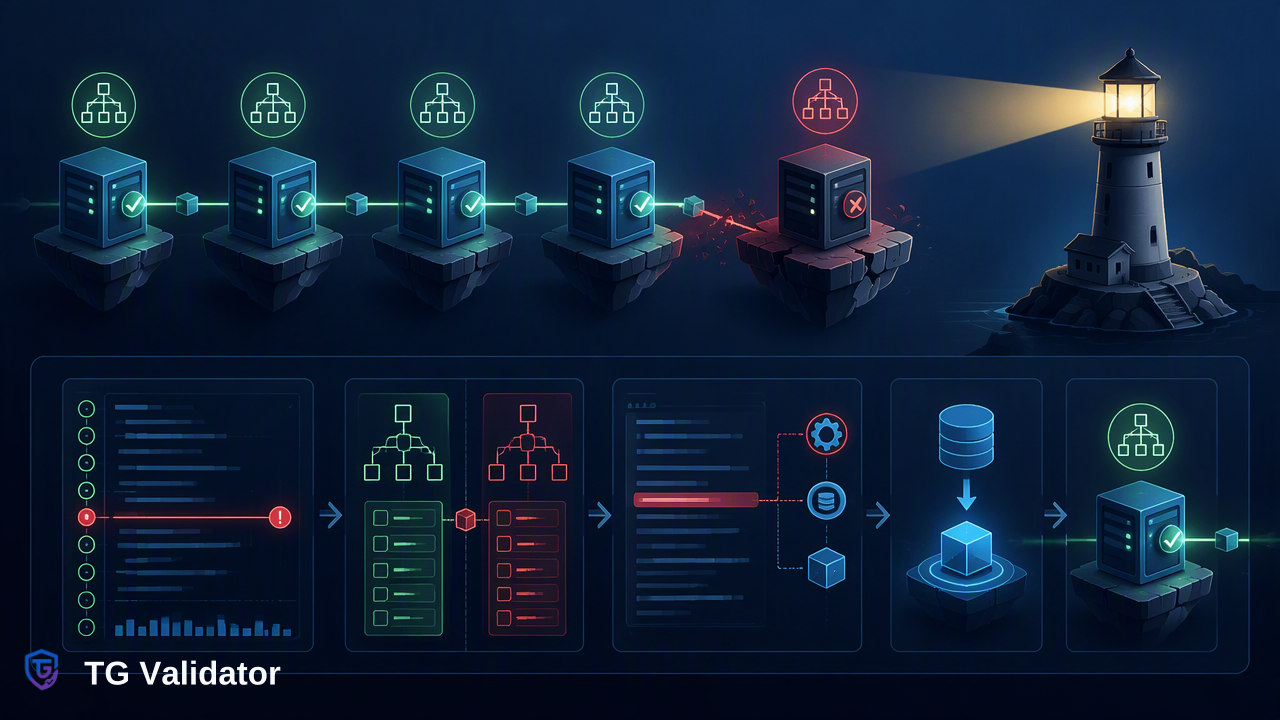
Identifying and Resolving Non-Deterministic Execution Paths in Distributed State Machines
Non-deterministic state transitions in distributed systems often stem from subtle environmental dependencies, such as system clock drift or unconstrained floating-point arithmetic, which break consensus; this article demonstrates how to isolate these sources of divergence through systematic execution tracing and state-root comparison.

In distributed systems, the promise of consensus is that every node, given the same sequence of inputs, will arrive at the identical state. When a validation node begins producing state roots that diverge from the majority of the peer set, the system enters a state of "split-brain" divergence. This is rarely caused by a catastrophic hardware failure; more often, it is the result of subtle, non-deterministic execution paths that only manifest under specific environmental conditions.
The Anatomy of Divergence
Consider a scenario where a node processes a transaction that involves a timestamp-based reward calculation or a floating-point operation. If the node relies on the local system clock rather than the consensus-agreed block time, or if it uses a floating-point library that behaves differently across CPU architectures (e.g., x86 vs. ARM), the resulting state root will deviate.
A common, frustrating observation is that the node passes all local unit tests but fails during network synchronization. This happens because unit tests often use mocked environments, whereas the live network provides real-world inputs—such as varying network latency or specific transaction ordering—that trigger these hidden dependencies.
Step 1: Isolating the Divergence Point
To resolve this, you must move beyond logs and implement a side-by-side execution trace. The goal is to identify the exact instruction where the local state machine deviates from the canonical state.
Start by capturing the state root at the beginning of a block execution. Then, instrument your virtual machine or execution engine to log the state of the stack, memory, and registers after every opcode or instruction.
# Conceptual trace logging for a state machine
def execute_instruction(instruction, state):
    pre_state_hash = calculate_state_hash(state)
    result = perform_op(instruction, state)
    post_state_hash = calculate_state_hash(state)

    # Log the transition for comparison
    trace_logger.info(f"Op: {instruction.name} | Pre: {pre_state_hash} | Post: {post_state_hash}")
    return result
By comparing this trace against a trace from a "known good" node, you can perform a binary search to find the first instruction where the post_state_hash differs.
Step 2: Analyzing Environmental Dependencies
Once you have identified the failing instruction, examine the inputs. If the instruction involves an external data source, verify that the data is being fetched from the consensus layer and not from a local cache or a local system call.
A frequent culprit is the use of non-deterministic system calls. For example, if your code performs a check like if (current_time() > threshold), and current_time() pulls from the local OS clock, the node will diverge the moment the local clock drifts by even a few milliseconds relative to the network.
Counterexample: Avoid using local environment variables for logic that affects state. If you need to check if a phone number is registered on a platform like Telegram, do not rely on a local database that might be out of sync. Instead, use a synchronous, reliable service to fetch the registration status. When integrating such services, ensure the request is handled synchronously within the execution flow to maintain determinism.
// Example of a deterministic external data request
POST /api/v1/check
{
  "service_type": "tg",
  "identifier": "+15550109999"
}
If the service returns a registered boolean, ensure that this value is treated as an immutable input for the remainder of the block execution. If the service returns a non-zero business code (indicating an undetermined state), the node must halt or retry rather than assuming a default value, as an assumption would introduce non-determinism.
Step 3: Addressing Floating-Point Arithmetic
If the divergence occurs during a mathematical operation, the issue is likely floating-point non-determinism. Different compilers and hardware architectures handle rounding modes (e.g., IEEE 754) differently.
The standard engineering trade-off here is performance versus precision. To ensure consensus, you must replace floating-point arithmetic with fixed-point arithmetic. By representing all values as integers (e.g., multiplying by 10^18 and using BigInt types), you ensure that the calculation is identical regardless of the underlying hardware.
Step 4: Verification via State-Root Comparison
After applying a fix, you must verify that the node now matches the canonical state. Do not rely on the node's own reporting. Instead, run a "shadow" execution where you feed the node the same sequence of transactions as the canonical chain and compare the resulting state roots at every block height.
If the state roots match for a significant number of blocks, you have likely resolved the non-deterministic path.
Key Takeaways for Distributed Systems
- Clock Drift is a Logic Error: Never use local system time for state-dependent logic. Always use the timestamp provided by the consensus protocol.
- Trace, Don't Guess: When state roots diverge, the only way to find the root cause is to compare execution traces instruction-by-instruction against a known-good peer.
- Fixed-Point is Mandatory: Floating-point arithmetic is inherently non-deterministic across different hardware. Use integer-based fixed-point math for all consensus-critical calculations.
- External Data Must Be Synchronous: When fetching external data, ensure the request is synchronous and the result is treated as an immutable input. If the data cannot be retrieved, the state machine must fail safely rather than guessing.
- Understand Your Limits: When using external validation services, be aware of concurrency and timeout behaviors. Design your client-side logic to handle these signals explicitly, ensuring that a timeout or a concurrency rejection does not lead to an undefined state in your local machine.
By systematically isolating the divergence point and eliminating environmental dependencies, you can ensure that your node remains a reliable participant in the distributed network. The goal is to treat the state machine as a pure function: given the same input and the same starting state, it must always produce the same output.